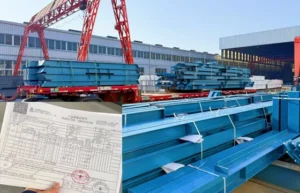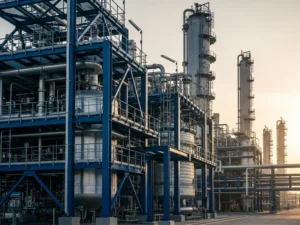
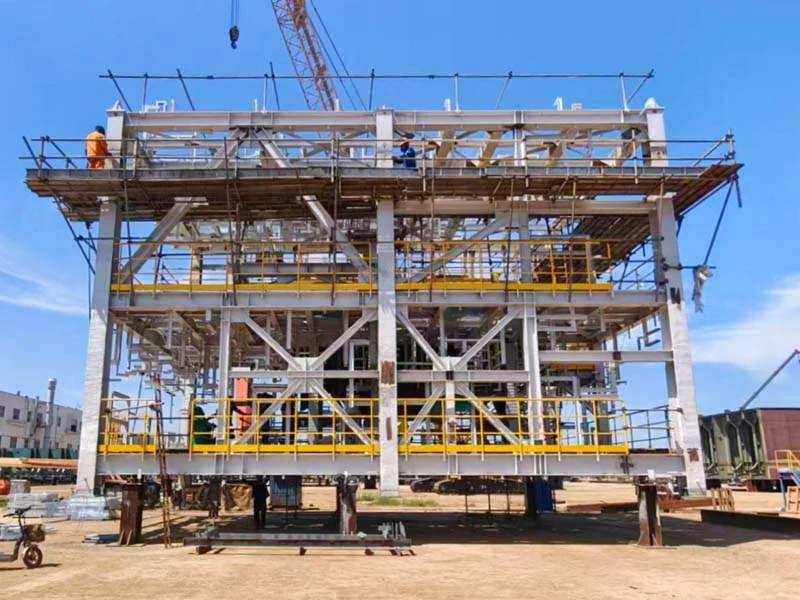
Petrochemical plant construction is becoming increasingly complex. Large-scale process facilities require extensive steel structures, pipe racks, equipment support frames, access platforms, and interconnected structural systems. At the same time, EPC contractors must manage demanding project schedules, welding quality requirements, site safety, and installation constraints.
Traditional stick-built construction, in which structural components are delivered to the site and assembled piece by piece, remains suitable for many projects. However, it can create challenges when site space is limited, multiple trades compete for the same work areas, or construction schedules leave little room for delays.
Modular construction offers an alternative by transferring a greater proportion of fabrication and assembly from the construction site to a controlled manufacturing environment.
For petrochemical steel structures, this approach can improve fabrication consistency, reduce the amount of work required at the site, and support more predictable project execution. Its success, however, depends on early engineering coordination, practical module design, transportation planning, and the fabricator's ability to manufacture structures in accordance with approved drawings and project specifications.
This article explains how modular construction works, its benefits for petrochemical steel structures, and the key considerations for EPC contractors and project owners.
1. Stick-Built Construction vs. Modular Construction
The fundamental difference between stick-built and modular construction is where structural fabrication and assembly take place.
Stick-Built Construction
In a traditional stick-built approach, individual steel members are transported to the construction site. Structural assembly, welding, and related installation activities are then performed largely in the field.
This method offers flexibility when design changes are expected, transportation restrictions limit module dimensions, or site conditions favor conventional erection.
However, it can also expose construction activities to weather conditions, limited working space, and coordination conflicts between structural steel, piping, mechanical equipment, electrical systems, and other disciplines.
Field welding and elevated work may require additional access arrangements, inspection coordination, and safety controls.
Modular Construction
Modular construction moves selected fabrication and assembly activities into a factory before the completed modules are transported to the site.
Depending on the project scope, a module may include structural steel frames, equipment support structures, platforms, stairs, and selected pre-installed piping or other systems.
The scope of each module varies according to the engineering design and project requirements. Structural steel modules do not necessarily include complete process systems or mechanical equipment.
At the site, the modules are positioned, connected, aligned, and integrated with foundations and adjacent structures.
| Project consideration | Stick-built construction | Modular construction |
|---|---|---|
| Fabrication location | Primarily at the construction site for field-assembled work | A greater proportion of fabrication takes place in the factory |
| Welding environment | Includes field welding and site-specific constraints | More welding can be completed in controlled workshop conditions |
| Site labor | Greater demand for on-site assembly activities | Some assembly work is transferred to the fabrication facility |
| Installation planning | Closely tied to site access and work sequencing | Requires earlier coordination of modules, transport, and lifting |
| Design flexibility | Can accommodate certain late-stage changes more easily | Changes after module fabrication may be more difficult and costly |
| Transportation requirements | Primarily individual members and components | May require oversized-load transport and heavy lifting |
| Quality control | Combines shop and field inspection activities | Allows more fabrication and inspection activities to be completed before delivery |
Neither approach is universally superior. The appropriate construction strategy depends on the project scale, structural configuration, site conditions, logistics, and total installed cost.
2. Why Modularization Is Gaining Importance in Petrochemical Projects
Several project requirements are encouraging the wider use of modular construction in the oil, gas, and petrochemical industries.
2.1 More Predictable Construction Schedules
Petrochemical facilities contain multiple interconnected systems. Structural steel installation must be coordinated with equipment setting, piping installation, electrical work, and civil construction.
When too many activities depend on the same site work areas, construction progress can become difficult to manage.
Factory fabrication allows selected structural components and modules to be manufactured while foundations and other site activities are progressing in parallel, provided that the engineering information and interfaces are sufficiently mature.
This overlap can reduce the amount of work remaining at the construction site and help improve schedule predictability.
However, the actual schedule benefit depends on procurement lead times, drawing approvals, fabrication capacity, transportation arrangements, and the readiness of the receiving site.
2.2 Improved Welding and Fabrication Control
Steel structures for petrochemical facilities may be subject to demanding welding, dimensional tolerance, material traceability, and inspection requirements.
Workshop fabrication provides a more controlled environment for cutting, fit-up, welding, dimensional inspection, and surface preparation.
Depending on the fabrication scope, moving work from the field to the workshop can reduce exposure to weather-related interruptions and improve access to welding positions.
A qualified fabrication process should include appropriate controls for:
- Material identification and traceability.
- Approved fabrication drawings and revision management.
- Welding procedure specifications and applicable qualification records.
- Welder qualifications and process control.
- Inspection and testing requirements.
- Dimensional verification and fit-up checks.
- Surface preparation and coating inspection, where specified.
- Nonconformance management and final documentation.
Factory fabrication alone does not guarantee quality. Results still depend on the manufacturer's quality management system, competent personnel, suitable equipment, and compliance with the project's applicable codes and specifications.
2.3 Reduced On-Site Work and Safety Exposure
Petrochemical construction sites often involve simultaneous operations, elevated work, heavy lifting, and restricted access.
Modularization can reduce selected field activities by completing more structural assembly and related work before delivery.
For example, certain platforms, stair assemblies, and equipment support frames may be fabricated and partially assembled in the workshop before being transported to the project site.
This can reduce the amount of field fit-up and welding required. It may also reduce the need for temporary access arrangements and some forms of elevated work.
Nevertheless, modular installation introduces its own safety considerations, including heavy-load transportation, crane operations, lifting plans, temporary stability, and module positioning. These activities require project-specific engineering and risk assessment.
2.4 Better Coordination Between Engineering and Fabrication
Modular construction requires design decisions to be made earlier than in many conventional construction workflows.
Structural dimensions, connection details, equipment interfaces, lifting points, transport clearances, and installation sequences must be coordinated before fabrication begins.
Three-dimensional modeling and BIM-based coordination can help engineering teams identify clashes between structural members, piping, equipment, and access requirements.
For steel structure fabricators, approved models and drawings can also support material planning, cutting lists, assembly sequencing, and dimensional verification.
The main benefit is not simply the use of 3D software. It is the coordination of engineering information so that the structures can be manufactured, transported, and installed as intended.
3. The Role of Steel Structure Fabrication in Modular Construction
Steel structure fabrication is a critical part of modular petrochemical projects because structural frames provide support for equipment, piping systems, operating platforms, and other plant components.
A modular strategy may involve several types of steel structures.
Pipe Rack Modules
Pipe racks support process and utility piping across petrochemical facilities. Depending on the design, transport conditions, and installation strategy, pipe rack structures may be divided into transportable sections or larger modules.
The module design must account for structural stability during lifting and transportation, connection accessibility, piping interfaces, and alignment at the installation site.
Connection details should be developed with both fabrication and field assembly in mind.
Equipment Support Structures
Equipment support frames transfer equipment loads to the supporting structure and foundations.
Their fabrication requires careful control of dimensions, support elevations, connection positions, and interface details. Where equipment alignment or baseplate positioning is critical, inspection requirements should be defined before manufacturing starts.
Modular fabrication can help establish these dimensions under controlled workshop conditions, but the final installation must still satisfy the approved engineering requirements.
Steel Platforms, Access Structures, and Stairways
Platforms, stairways, ladders, and access structures can sometimes be fabricated as subassemblies or integrated into larger modules.
Preassembly may reduce the amount of individual component installation required on site.
However, transport dimensions, temporary bracing, lifting access, and the risk of damage during handling must be considered when determining how much of the structure should be assembled in the factory.
Structural Frames for Packaged and Skid-Mounted Units
Packaged equipment and skid-mounted systems often rely on structural steel bases or supporting frames.
These structures may need to accommodate equipment interfaces, piping connections, lifting arrangements, and transportation loads.
Fabrication drawings should therefore reflect the complete interface requirements, rather than treating the steel frame as an isolated product.
The appropriate fabrication scope depends on the package supplier's responsibilities, the EPC contractor's design, and the division of work defined in the contract.
4. Key Engineering Considerations Before Modularization
Modular construction requires more than dividing a conventional structure into smaller pieces. The module configuration must be suitable for manufacturing, transportation, lifting, and final installation.
4.1 Transportation Dimensions and Weight
Transportation constraints are among the most important factors in module design.
The engineering team should assess the complete transportation route, including road width, bridge capacity, overhead clearances, turning radii, access restrictions, and any applicable permit requirements.
For projects using marine or inland waterway transport, vessel dimensions, deck loading, port facilities, and unloading arrangements may also affect the module configuration.
Module weight must be evaluated together with its center of gravity, lifting arrangement, and temporary structural behavior.
A module that is efficient to fabricate may still be impractical if it cannot be transported to the site or positioned using the available lifting equipment.
4.2 Lifting Design and Temporary Stability
A structure designed for its final operating condition may experience different forces during lifting and transportation.
Lifting points, temporary bracing, support locations, and the structural response during handling should be considered as part of the engineering process.
The lifting plan must be coordinated with the module's actual weight, center of gravity, rigging arrangement, crane capacity, and site conditions.
These requirements should be addressed before fabrication wherever they affect structural details or the manufacturing sequence.
4.3 Connection Design and Site Assembly
Module interfaces influence both fabrication efficiency and installation productivity.
Connections should be designed to provide adequate structural performance while remaining accessible for installation, bolting, welding, inspection, and any required adjustment.
Dimensional tolerances between adjoining modules are particularly important. Small discrepancies can create significant installation difficulties when several structural sections must align with piping, equipment, or foundation interfaces.
A coordinated dimensional control plan helps define critical measurements, inspection points, and acceptance criteria before delivery.
4.4 Design Freeze and Revision Control
Modular fabrication generally requires earlier decisions on structural configuration and interface dimensions.
Late changes to equipment locations, piping routes, connection details, or support elevations can lead to rework, additional inspection, and schedule disruption.
Before manufacturing begins, the project team should establish an appropriate approval process for fabrication drawings, interface information, and relevant design revisions.
A clear document control system helps ensure that workshop personnel manufacture the correct revision and that the delivered modules match the approved design.
4.5 Factory Capacity and Quality Documentation
A modularization strategy must match the fabrication contractor's actual capabilities.
Relevant considerations include workshop space, lifting capacity, welding facilities, material handling equipment, dimensional inspection capability, surface treatment arrangements, and the ability to manage large assemblies.
The project team should also define the required quality records and inspection documentation before production begins.
Depending on the contract and applicable standards, these may include material certificates, material traceability records, welding documentation, inspection and test records, dimensional reports, coating records, and final manufacturing dossiers.
A well-defined documentation process helps the EPC contractor verify that the fabricated structures comply with the approved requirements.
5. When Is Modular Construction the Right Choice?
Modularization should be evaluated on a project-by-project basis. It is not automatically the most economical option for every petrochemical facility.
| Project factor | Potential implication |
|---|---|
| Large and repetitive structural scope | May improve the economics of factory fabrication and repeated assembly operations |
| Limited site space | May favor transferring selected activities away from the construction site |
| High local labor or site establishment costs | May strengthen the case for workshop fabrication |
| Restricted transport routes | May require smaller modules or a more conventional construction approach |
| Limited crane capacity | May constrain module size, weight, and installation sequence |
| Frequent design changes | May increase the risks associated with early fabrication commitments |
| Mature engineering and coordinated interfaces | Can support more reliable module production and installation |
| Remote project location | Requires careful comparison of fabrication, transport, mobilization, and site costs |
The economic evaluation should compare the total installed cost, not just the workshop fabrication price.
Relevant costs include engineering, temporary works, transport, permits, lifting equipment, module assembly, site connections, inspection, rework risks, and schedule-related costs.
For some projects, a hybrid strategy may be the most practical solution. Major structural assemblies can be fabricated in the workshop, while selected connections, adjustments, and installation activities remain at the site.
This approach allows the project team to capture the benefits of factory fabrication without forcing every structural component into a modular configuration.
6. How to Evaluate a Petrochemical Steel Structure Fabricator for Modular Projects
Selecting a fabricator for modular petrochemical construction requires more than checking production capacity or the lowest quotation.
EPC contractors should assess whether the supplier can consistently manufacture structures in accordance with approved drawings, project specifications, and interface requirements.
Key evaluation points include:
Engineering and Drawing Coordination
Can the supplier interpret approved fabrication drawings, manage revisions, coordinate connection details, and identify dimensional or interface issues before production?
Welding Quality and Inspection
Are applicable welding procedures, welder qualifications, inspection activities, and nonconformance controls properly managed?
Dimensional Control
Can the manufacturer verify critical dimensions, connection positions, support elevations, and module interfaces before shipment?
Material Traceability
Can structural steel materials be identified and traced through the relevant stages of fabrication, where required by the project specification?
Surface Preparation and Coating
Can the supplier meet the specified surface preparation, coating system, inspection, and documentation requirements?
Manufacturing and Lifting Capacity
Does the facility have the space, equipment, and handling capability required for the proposed assemblies? Can the fabrication sequence support the planned delivery schedule?
Packaging, Shipment, and Documentation
Can the supplier prepare the structures for the agreed transportation method and provide the required inspection records, identification, shipping documentation, and manufacturing dossier?
These capabilities are particularly important when the fabricated structures will be integrated with equipment, piping, and other modules supplied by different contractors.
7. The Future of Modular Construction in Petrochemical Projects
The continued development of modular construction depends on closer integration between engineering, fabrication, logistics, and installation.
Three-dimensional design, digital coordination, and more structured manufacturing data can help project teams manage complex interfaces and reduce avoidable fabrication errors.
At the same time, modularization requires disciplined project planning. Transport and lifting constraints must influence module design from the beginning, fabrication must follow approved information, and installation requirements must be considered before assemblies leave the factory.
For petrochemical steel structures, the most effective strategy is not necessarily to maximize the size or number of modules. It is to identify which structures and assemblies can be fabricated and transported efficiently while maintaining quality, safety, and installation reliability.
Conclusion
Modular construction is changing how petrochemical facilities are engineered and built by transferring selected activities from construction sites to controlled manufacturing environments.
For steel structures, the approach can improve fabrication control, support parallel project activities, and reduce the amount of field assembly required. Realizing these benefits depends on coordinated engineering, practical module design, reliable dimensional control, transportation planning, and a capable fabrication partner.
For EPC contractors and project owners, the key question is not simply whether to adopt modular construction. It is how to define the appropriate fabrication scope and module boundaries for each project.
A steel structure fabricator that understands manufacturing requirements, quality documentation, dimensional accuracy, and installation interfaces can make an important contribution to successful modular project delivery.
Planning a petrochemical steel structure or modular fabrication project?
Contact our team to discuss your fabrication scope, technical requirements, quality documentation, and project delivery needs.